These notes capture homeowner research so we can have an informed conversation. Please lean on your expertise—treat everything here as talking points, not directives.
Overview
- Project: 24’x40’ three-bay garage with loft; in-slab radiant heat on main level.
- Goal: collaborate on slab pour that supports radiant heating, center drain, future lift, and embedded utilities.
- Contractor expertise leads; items below reflect homeowner assumptions to confirm or adjust together.
- Reference sequence: Sequence to build garage — Stage 2 (Pour Concrete Slab).
- 2025-10-13 contract locks 8”x42” rat wall, 4” slab over 2” Creatherm foam, and 1/2” PEX radiant tubing with sleeves for sewer/water/electric/fiber. Use this brief to close remaining gaps (lift bay pads, drain slope, documentation).
Progress Log
- 2025-11-03 — Final grading and entry surface work completed, marking the end of cement contractor scope. Crew used dirt and sand pile to create smooth transition ramp from driveway to slab, with 2’-3’ dirt ramp around remaining three perimeter edges. Slab foundation work complete; site ready for vertical construction phase.
- Video: Final Grading Time-Lapse
- 2025-10-21 — Hydronic radiant floor materials delivered to the jobsite; crews stood down because of storms. Logged under Radiant Slab Materials Order with invoice archived at Hydronic Heating Materials Delivery.
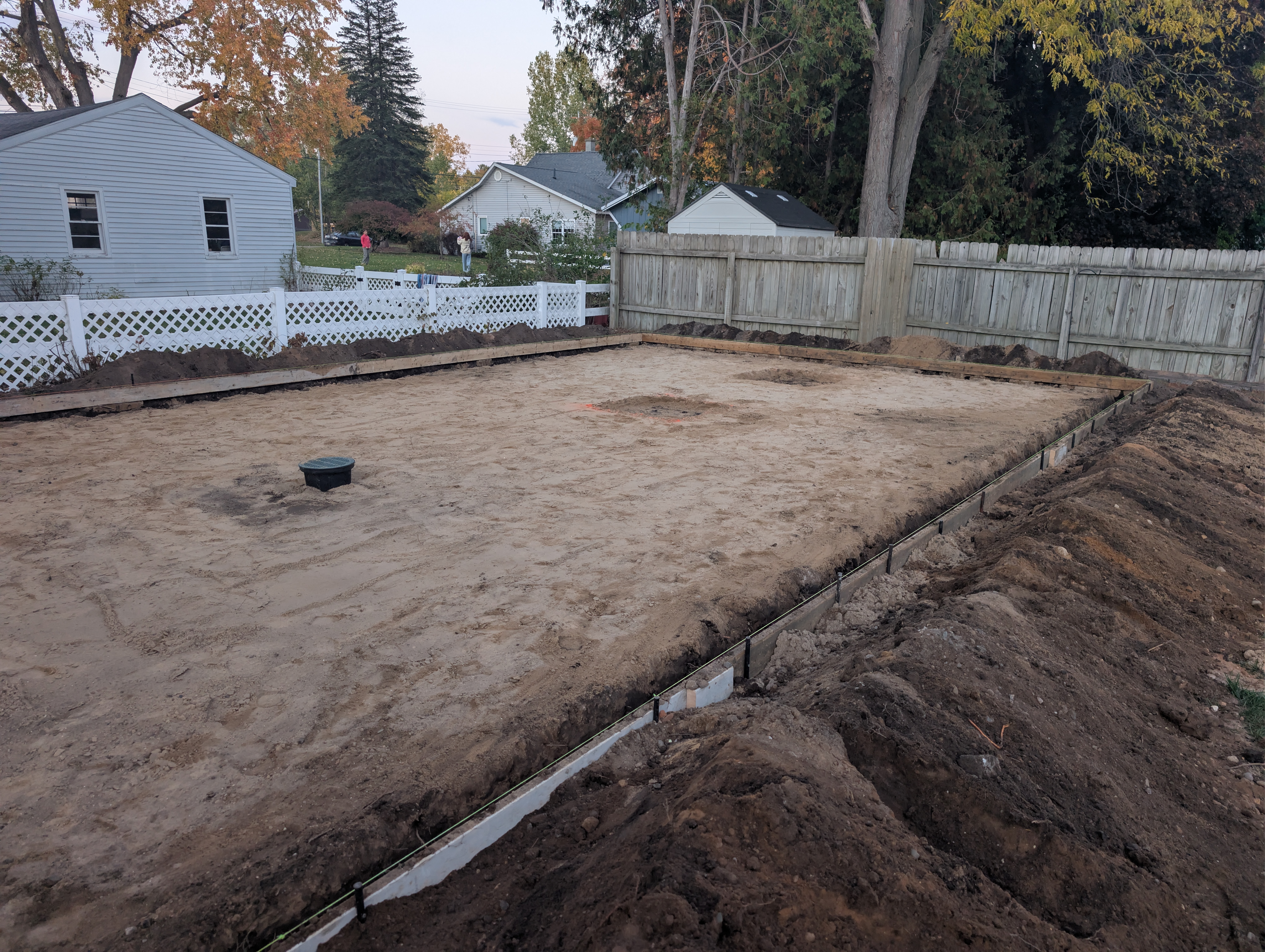
- 2025-10-20 — Subgrade prep completed: existing sod stripped, sand base leveled and compacted, and slab forms set with 2’ perimeter trench cut for the rat wall. Lift bay pads were staked and dug; Bay 3 kept level for the future lift while Bays 1-2 slope to the center drain tied to the rear daylight line. Foam perimeter board still to be installed ahead of insulation/PEX work.
- Photo:
- Photo:
Immediate Next Steps
- Coordinate with Hershberger crew on floor foam, PEX layout, and underground conduit placement before inspection — stage:: 2
- Confirm exterior perimeter foam installation once concrete contractor returns — stage:: 2
- Verify floor drain piping and cleanout placement prior to PEX install — stage:: 2
- Confirm delivered hydronic materials inventory and weather protection plan — stage:: 2
Layout & Elevations — Topics to Review
- Full 24’x40’ slab with three overhead doors on driveway face; third (east) bay reserved for future 2-post lift — see Lift.
- Desire: confirm finished-floor elevation relative to door thresholds and exterior grade before pour.
- Lift bay request: understand how to keep Bay 3 level per lift manufacturer guidance while still managing drainage across the rest of the slab.
Subgrade & Insulation — Current Understanding
- Expecting compacted granular base (target 4”-6” of 21AA or equivalent) over prepared subgrade; happy to follow your recommended depth/spec.
- Planning for continuous R-10 rigid foam (2” XPS/EPS) beneath the heated slab, with perimeter insulation where foundation detail allows.
- Hoping to keep vapor barrier continuous (6-mil poly above insulation, taped seams, brought up stem walls); open to better approaches you recommend.
Reinforcement & Concrete — Assumptions to Validate
- Thinking #4 rebar grid at 12” o.c. each way on chairs, plus supplemental bars at edges/openings, unless you recommend an alternative.
- What slab thickness do you prefer here? We have seen 4” called out as common, but we are open to thicker sections (especially in the lift bay) if you feel it is warranted.
- Mix we researched: 4,000 PSI air-entrained concrete around 4”-5” slump (with water reducer if adjustment needed)—open to your go-to mix design.
- How do you like to handle control joints with radiant tubing? We want to avoid cutting into the PEX, so we are eager to follow your preferred layout/technique.
Floor Drain & Slope — Questions
- Prior decision: single 4” round floor drain centered left-to-right with a 6” offset toward the rear wall (see Decisions Log).
- How would you recommend sloping the two non-lift bays toward that drain while holding Bay 3 level? Open to transitions, trench breaks, or other strategies you trust.
- Drain piping intended to daylight/French drain per site utilities; happy to coordinate sleeve details and sealing method you prefer.
Radiant PEX Layout — Coordination Items
- Radiant contractor plans 1/2” oxygen-barrier PEX tied to rebar grid. Current idea: 9” spacing in vehicle zones, tightened to ~6” along exterior walls/main entry; will follow designer’s final plan.
- Loop count target is 3-4 per bay; we’ll label supply/return pairs and route to manifold in mechanical room (see Mechanical Room for location).
- Intention is to maintain 6” clearance from walls, drains, and anchor lines, plus a 12” buffer around lift pads; please flag if that needs adjustment for placement/finishing.
- We plan to pressure-test to 60 PSI (or designer spec) and photograph layout before pour—let us know the best way to keep tubing protected during placement.
- Contract commit: tubed slab is included, but lift-bay PEX exclusion pads still need explicit confirmation before install.
Lift Column Pads (Bay 3) — Considerations
- Manufacturer guidance suggests two 4’x4’ PEX-free pads on the bay centerline, roughly 10’6”-11’ apart; happy to follow spacing and reinforcement you recommend.
- Bay 3 floor should remain level for lift install; looking for your direction on how best to integrate that with the rest of the slab and any joint layout.
- We’ll capture measurements/photos after tubing install so anchors avoid PEX—please share any documentation you like to see for future reference.
Embedded Sleeves & Conduits — Items to Coordinate
- Anticipated sleeves before vapor barrier taping (all through slab):
- Electric service conduit to future panel (mechanical room wall).
- Natural gas sleeve with capped riser at mechanical room.
- Domestic water and sewer sleeves to mechanical room manifold area.
- 2” (min) PVC conduit for low-voltage/data run to house, pull string left in place.
- Spare conduit toward exterior wall for future solar PV or EV service if you think it makes sense to stub now.
- Idea: route sleeves under the slab and daylight them just beyond the front edge so they can be capped and buried until needed; open to the routing approach you prefer.
- Plan to label and photograph each sleeve; welcome any tips on sealing penetrations that you find hold up best.
Documentation & QA — What We Plan To Capture
- Track action items in Utilities & Conduits (sleeves, PEX pressure test, photo log).
- After pour, mark manifold stub-out, drain, and sleeve locations for future trades unless you have a preferred method.
- Collect batch tickets, mix/PSI confirmations, curing notes, and saw-cut layout from you for our records (happy to receive scans or photos as convenient).
Open Questions Before Pour
- Final mechanical room wall layout and manifold height references (pending owner confirmation).
- Drain discharge route and any freeze protection you recommend.
- Preferred lift column spacing/anchor pattern once model is selected.
- Need for additional thickened pads (compressor, equipment) from your point of view.
Thanks in advance for walking through these points with us—we appreciate any guidance or revisions you suggest.