Truss Layout Schematic - Large Format Drawing
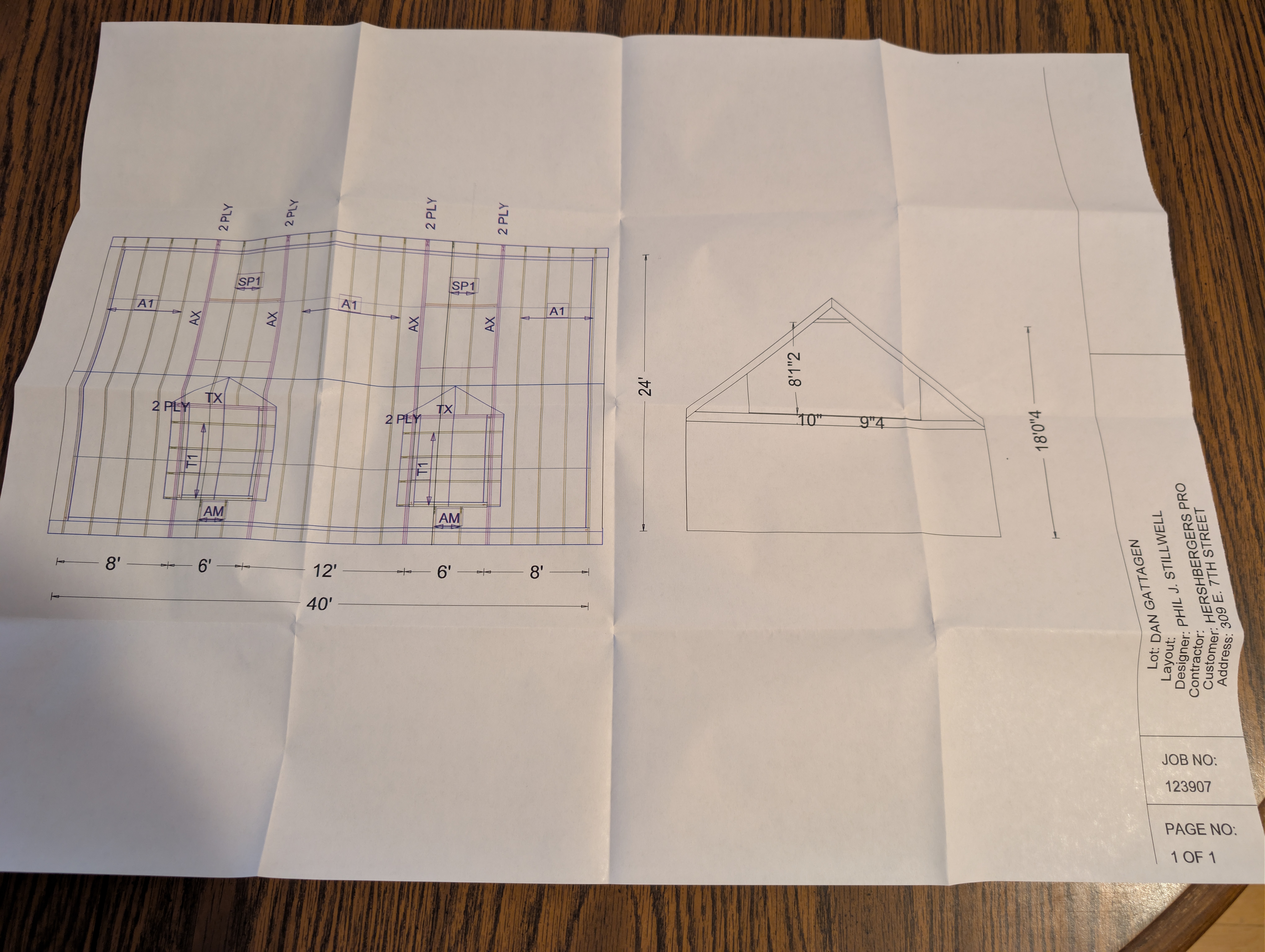
Photo Details
- Date: November 18, 2025
- Time: 1:04 PM EST
- Weather: Cloudy, 39°F. Indoor photo documentation.
- Phase: Framing preparation – engineering documentation
- Location: 309 E. 7th St., Clare, MI – indoor documentation
- Subject: Large-format truss layout schematic (too large for standard scanner)
Description
Large engineering schematic drawing showing the complete truss layout and configuration for the 24’ x 40’ garage roof system. This drawing was included in the truss delivery packet and provides the master reference for truss placement during framing.
Document Details
Engineering Drawing Information:
- Job Number: 123907 (visible on right side of drawing)
- Page: 1 of 1 (layout drawing)
- Source: Letherer Truss Inc., Clare, Michigan
- Designer: Phil J. Stillwell
- Drawing Type: Truss placement layout with profile elevation
Visible Elements
Left Section - Floor Plan Layout:
- Building Footprint: 24’ wide x 40’ long rectangular plan
- Bay Spacing: Five 8-foot bays marked across the 40’ length
- Dimensions: Labeled as 8’ - 8’ - 12’ - 8’ - 8’ = 40’ total
- Truss Positions: Individual truss locations marked with designations (A1, AX visible)
- Grid Reference: Shows precise placement of each truss type
- Width Markings: 24’ width clearly dimensioned
Right Section - Truss Profile:
- Elevation View: Side profile showing roof pitch and truss geometry
- Pitch: 10:12 slope visible in profile
- Height: Approximately 11’ peak height shown
- Overhang: 1’ overhang on each side indicated
- Truss Shape: Standard attic truss configuration with flat bottom chord
Labeling & Annotations:
- Truss type callouts (A1, AX, SP1, etc.) on layout
- Dimensional annotations throughout
- Job information panel on right edge
- Construction notes and specifications
Physical Document Characteristics
- Paper Size: Large-format engineering drawing (approximately 24” x 36”)
- Condition: Folded for transport in delivery packet
- Material: Standard architectural bond paper
- Printing: Black line drawing on white background
- Fold Marks: Multiple creases visible from folding for delivery
Documentation Context
This photograph was taken because the drawing was too large to fit on the standard scanner bed. The large-format schematic provides:
- Installation Reference: Exact truss placement for framing crew
- Type Identification: Shows which truss type goes in each position
- Dimensional Control: Verifies 8’ bay spacing and 24’ width
- Elevation Check: Confirms roof pitch and overhang specifications
- Building Inspector Reference: Allows verification against approved plans
Technical Specifications from Drawing
Building Dimensions:
- Length: 40’ (five 8’ bays)
- Width: 24’
- Roof Pitch: 10:12 (10” rise per 12” run)
- Overhangs: 1’ on each gable end
- Peak Height: ~11’-3” (11 feet, 3-8/16 inches per loading ticket)
Truss Inventory (as cross-referenced with loading ticket):
- 13x A1 24’ Attic trusses (standard)
- 4x AX 24’ Attic Girder trusses (load-bearing)
- 4x SP1 14’6” Special trusses
- 8x T1 6’ Common trusses
- 2x TX 6’ Common Girder trusses
- 4x AM 2’ Mono trusses
Relationship to Other Documentation
This layout drawing is page 1 of the 8-page engineering packet delivered with the trusses. The subsequent pages (2-8) provide detailed engineering calculations and connection specifications for each truss type shown on this layout.
Cross-Reference:
- Layout drawing (this photo) = Page 1 of packet
- Pages 2-3 = PLY-1 QTY-4 engineering details
- Pages 4-5 = PLY-1 QTY-13 engineering details
- Page 6 = PLY-2 QTY-2 engineering details
- Page 7 = PLY-1 QTY-8 engineering details
- Page 8 = PLY-1 QTY-4 mono truss details
Construction Phase Impact
This schematic is the primary reference document that the framing crew will use to:
- Identify Trusses: Match each physical truss to its designated position
- Verify Spacing: Ensure proper 8’ on-center bay spacing
- Confirm Orientation: Orient attic trusses correctly (gable vs. rake ends)
- Plan Lifting: Sequence truss installation from one end to the other
- Inspect Work: Building inspector can verify placement against engineered plans
Installation Sequence Implied
Based on the layout, the typical installation sequence will be:
- Install gable end trusses first (likely the AX girder trusses)
- Work from one end to the other installing A1 standard attic trusses
- Install intermediate common trusses (T1/TX)
- Complete with mono trusses and special configurations (AM, SP1)
- Install temporary bracing per T.P.I. standards
- Add permanent lateral bracing and sheathing
Related Notes
- Truss delivery packet - Complete 8-page engineering document set
- Truss loading ticket - Delivery manifest with truss inventory
- PXL_20251118_163615779 - Photo of trusses delivered to slab
- Timeline - Truss delivery and framing timeline
- 2025-11-13 - Call - Marcus Framing Schedule - Framing crew mobilization schedule
Why This Photo Exists: This drawing was too large to scan on a standard flatbed scanner, so it was photographed to preserve the complete layout information digitally. The original paper drawing will be kept onsite during construction as a field reference for the framing crew.